
How to Use Parking Meters in Tokyo: Signs, Fees, Sundays and Holidays
Tokyo has 752 street segments with parking meters or parking tickets, officially called time-limited parking zones. The signs and meters are in Japanese, and each segment has its own hours and rules for Sundays and holidays. This guide explains how they work, and the free map on this site shows every segment in color.
Quick facts
- Time limit: 60 minutes at most spots (some 40 or 20 minutes). No extensions.
- Fee: usually 300 yen per time limit (some 200 or 100 yen).
- Hours: most commonly 9:00–19:00; others 8:00–20:00, 7:00–20:00 or 9:00–21:00.
- Sundays and holidays: 250 of 752 segments also operate on Sundays and holidays; the rest are out of service. All are out of service from January 1 to 3.
- Payment: cash only at meters: 100-yen coins, paid right after parking. No bills or cards.
1. How to read the sign
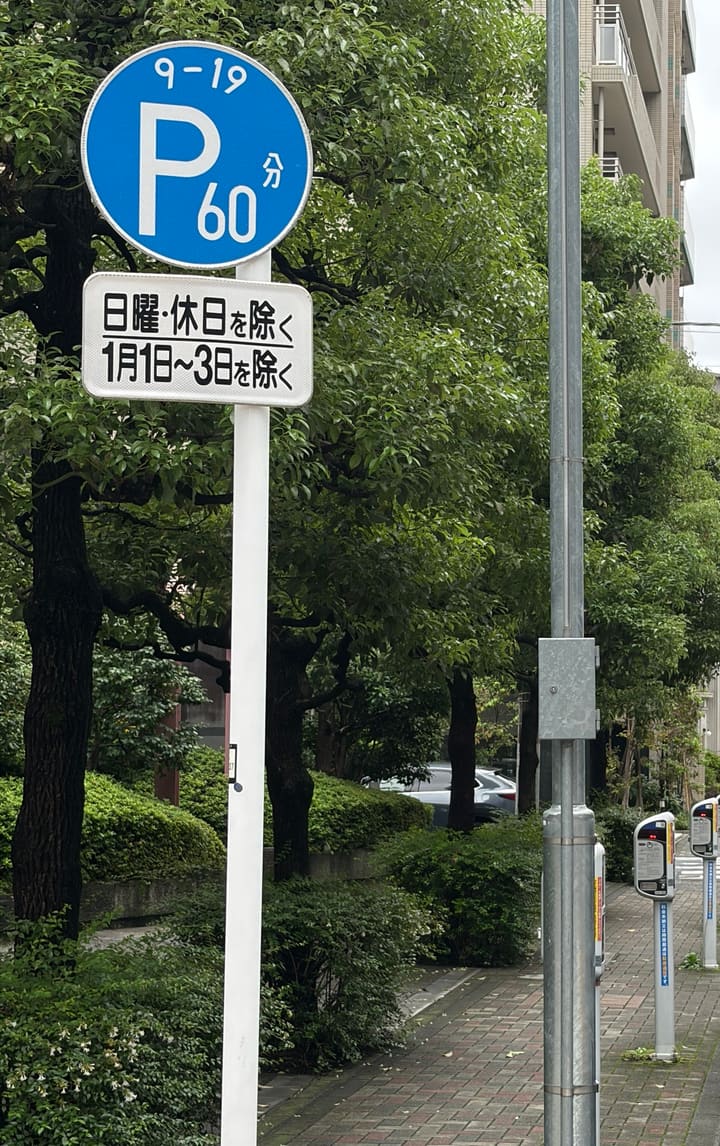
A meter zone is marked by a round blue sign with a white P. Reading the sign in the photo:
- 9-19 (top): the zone operates from 9:00 to 19:00.
- P 60分: time-limited parking, up to 60 minutes (分 = minutes).
- 日曜・休日を除く: except Sundays and public holidays. On those days the meter is out of service and the zone is not in effect.
- 1月1日〜3日を除く: except January 1–3 (New Year holidays).
Remember: when the zone is not in effect, the street's other rules apply. See section 4 before parking at those times.
2. Two types: digital meter or sticker ticket
Tokyo has two kinds of time-limited parking. Both are prepaid and cannot be extended.
One meter per space, on the sidewalk next to it. Insert coins and the display counts down the minutes you have left. Most zones in Tokyo are this type.
One ticket machine for several spaces. It prints a sticker ticket showing the time you must leave by. Display it inside your windshield.
How to use a digital parking meter
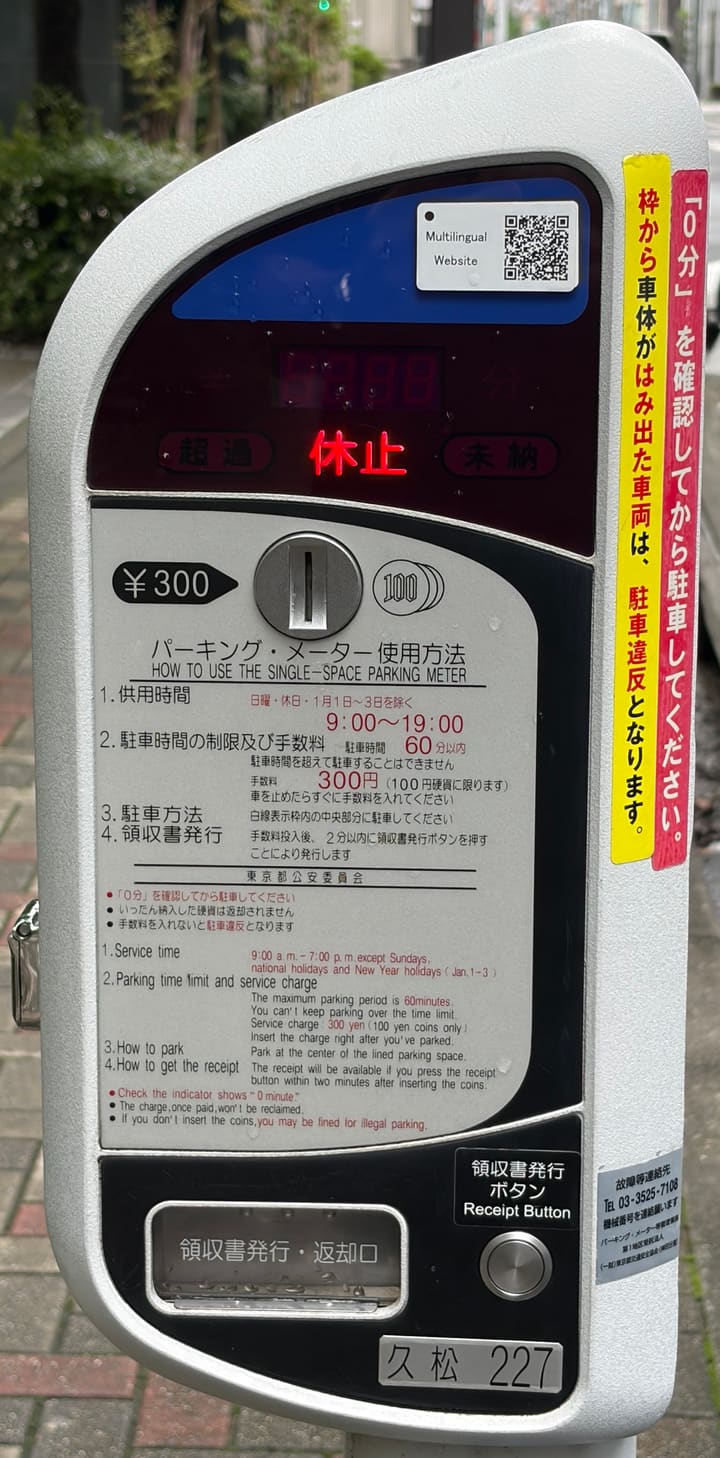
- Check the display shows 0 minutes before you park. The red sticker on the side (「0分」を確認してから駐車してください) says exactly this.
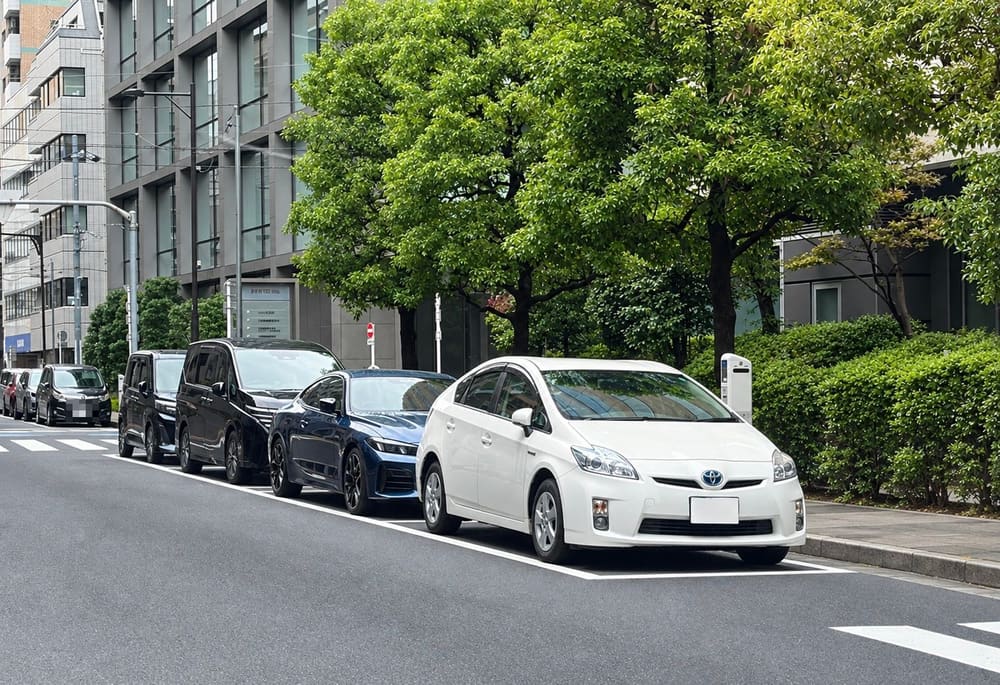
- Park in the center of the white-lined space (see the photo below). A car that sticks out of the space is a parking violation (the yellow sticker).
- Pay right after parking. Insert three 100-yen coins (300 yen), one at a time. Coins are not refunded once inserted.
- Receipt (optional): press the receipt button (領収書発行ボタン) within 2 minutes after paying.
- Leave within the time limit. You cannot pay again to stay longer. If you don't pay or stay too long, you may be fined for illegal parking.
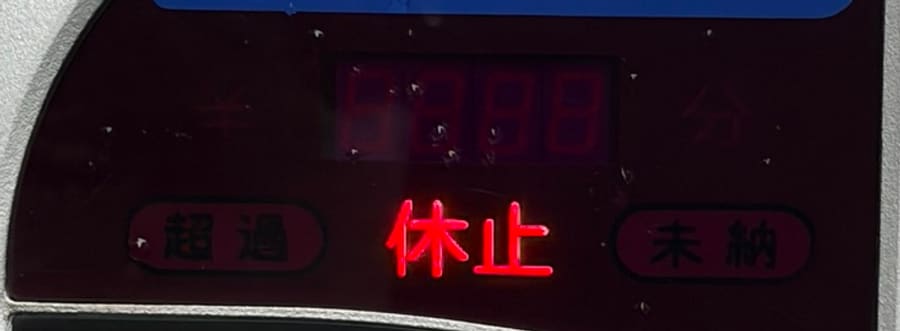
- 休止 (kyūshi): out of service. The meter is not operating today or at this hour.
- 未納 (minō): unpaid. A car is parked but the fee has not been paid.
- 超過 (chōka): over the time limit.
Look for the Multilingual Website QR code on the meter for official instructions in other languages.
How to use a sticker parking ticket
- Check the zone is operating, then park inside a white-lined space.
- Go to the ticket machine for those spaces and pay the fee. It prints a ticket with the time you must leave by.
- Peel off the receipt part and display the ticket inside your windshield, with the printed end time readable from outside. Parking without a displayed ticket is a violation.
- Keep the receipt: if the ticket falls off, it shows you paid. Leave by the printed time; tickets cannot be extended.
3. Sundays and holidays: blue and green on the map
The map uses the same two colors as the Tokyo Metropolitan Police map.
- Blue: also operates on Sundays and holidays (日曜・休日も利用可). The meter runs and the fee applies during operating hours every day except January 1–3.
- Green: except Sundays and holidays (日曜・休日を除く). The meter is out of service on Sundays and holidays (a few also on Saturdays).
Areas with the most segments that operate on Sundays and holidays: Chiyoda City (106), Chuo City (49), Shibuya City (20), Taito City (19), Shinjuku City (15), Tama area (13). (Area pages are in Japanese.)
4. Before parking outside the operating hours
Many meter zones are set up on streets where parking is otherwise prohibited, as places where short stays are allowed during set hours. On days when the meter is out of service, or outside its hours, the original No Parking rule applies again. Look for a No Parking sign (駐車禁止: a blue circle with a red border and a red slash) and check the hours and days on its plate.
5. Where you can never park (Road Traffic Act)
These places are prohibited by law whether or not there is a sign (main examples):
- No stopping or parking: within 5 m of an intersection or a pedestrian/bicycle crossing, within 10 m of a railway crossing, safety zone or bus/tram stop sign (during service hours), near the top of a hill or on a steep slope, and in tunnels.
- No parking: within 3 m of a driveway or garage entrance, within 5 m of road works, fire hydrants or fire equipment, and within 1 m of a fire alarm.
- Anywhere that leaves less than 3.5 m of road on the right side of your car.
6. No long stays (Garage Law)
Under the Act on Securing Parking Spaces for Motor Vehicles (the Garage Law), leaving a car in the same place on a public road for 12 hours or more in the daytime, or 8 hours or more at night, is prohibited. Street meters are for short stays only.
7. Japanese terms you will see
On signs, meters and this site's map (the map screen is in Japanese):
| 時間制限駐車区間 | Time-limited parking zone (meter or ticket zone)jikan seigen chūsha kukan |
| パーキング・メーター | Parking meter (one meter per space)pākingu mētā |
| パーキング・チケット | Parking ticket (buy a ticket at a machine and display it)pākingu chiketto |
| 60分 | Time limit: 60 minutesroku-juppun |
| 9-19 / 8-20 | Operating hours: 9:00–19:00 / 8:00–20:00 |
| 日曜・休日を除く | Except Sundays and public holidays (meter not in service)nichiyō kyūjitsu o nozoku |
| 土・日曜、休日を除く | Except Saturdays, Sundays and public holidaysdo nichiyō kyūjitsu o nozoku |
| 1月1日〜3日を除く | Except January 1–3 |
| 駐車禁止 | No parkingchūsha kinshi |
| 駐停車禁止 | No stopping or parkingchūteisha kinshi |
| 休止 | Out of service (shown on the meter)kyūshi |
| 未納 / 超過 | Unpaid / Over the time limit (shown on the meter)minō / chōka |
| 供用時間 | Service hours (printed on the meter)kyōyō jikan |
| 100円硬貨に限ります | 100-yen coins only |
| 領収書発行ボタン | Receipt buttonryōshūsho hakkō botan |
| 手数料 | Feetesūryō |
| 利用時間 | Operating hours (on this site’s map)riyō jikan |
| 制限時間 | Time limit (on this site’s map)seigen jikan |
| 日曜・休日も利用可 | Also operates on Sundays and holidays (blue line on the map)nichiyō kyūjitsu mo riyō ka |
| ここにナビする | Navigate here (opens driving directions in Google Maps)koko ni nabi suru |
8. Using the map
- Lines on the roads are meter segments: blue operates on Sundays and holidays, green does not.
- Tap a line to see its operating hours (利用時間), time limit (制限時間), fee (手数料) and number of spaces.
- Tap ここにナビする ("Navigate here") to open driving directions in Google Maps.
- Use the funnel button to show only blue or only green segments, and the search button to find a station or place (English names such as "Ginza station" work too).
FAQ
- Q. Do parking meters in Tokyo operate on Sundays?
- A. It depends on the spot. Most meter zones in Tokyo have a plate reading 日曜・休日を除く ("except Sundays and holidays"), so the meter is out of service on those days. Some zones, mainly in busy districts, operate on Sundays and holidays too. All zones are out of service from January 1 to 3.
- Q. Can I park for free when the meter is out of service or outside its hours?
- A. Not necessarily. Outside the posted hours the time-limited parking rules simply do not apply. If the street has a No Parking sign (a red slash in a blue circle, sometimes with hours), parking is prohibited at those times. Places prohibited by law, such as near intersections, are off-limits even without a sign. Always check the signs on site.
- Q. How long can I park at a meter?
- A. Up to the time limit on the sign, which is 60 minutes at most spots in Tokyo (some are 40 or 20 minutes). You cannot extend by paying again; move your car when the time is up.
- Q. How much does a parking meter cost in Tokyo?
- A. Most spots charge 300 yen for the time limit (usually 60 minutes). Some charge 200 or 100 yen. The amount is shown on the meter and on this site’s map.
- Q. What payment do Tokyo parking meters accept?
- A. Cash only: 100-yen coins. Bills, credit cards and IC cards such as Suica cannot be used, so have three 100-yen coins ready for a 300-yen spot. Pay right after parking.
- Q. Can I leave my car on the street overnight?
- A. No. Under Japan’s Garage Law, leaving a car in the same place on a public road for 12 hours or more in the daytime, or 8 hours or more at night, is prohibited.
This page summarizes general information and is not legal advice. Rules may change. For the latest information, check the Tokyo Metropolitan Police Department website and the signs on site. 東京パーキングメーターマップ (Tokyo Parking Meter Map) is an independent site and is not affiliated with the police.